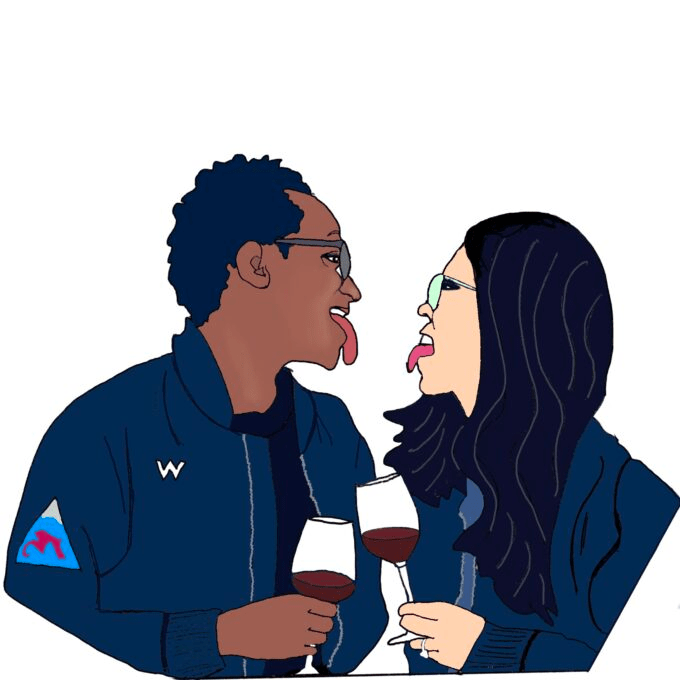
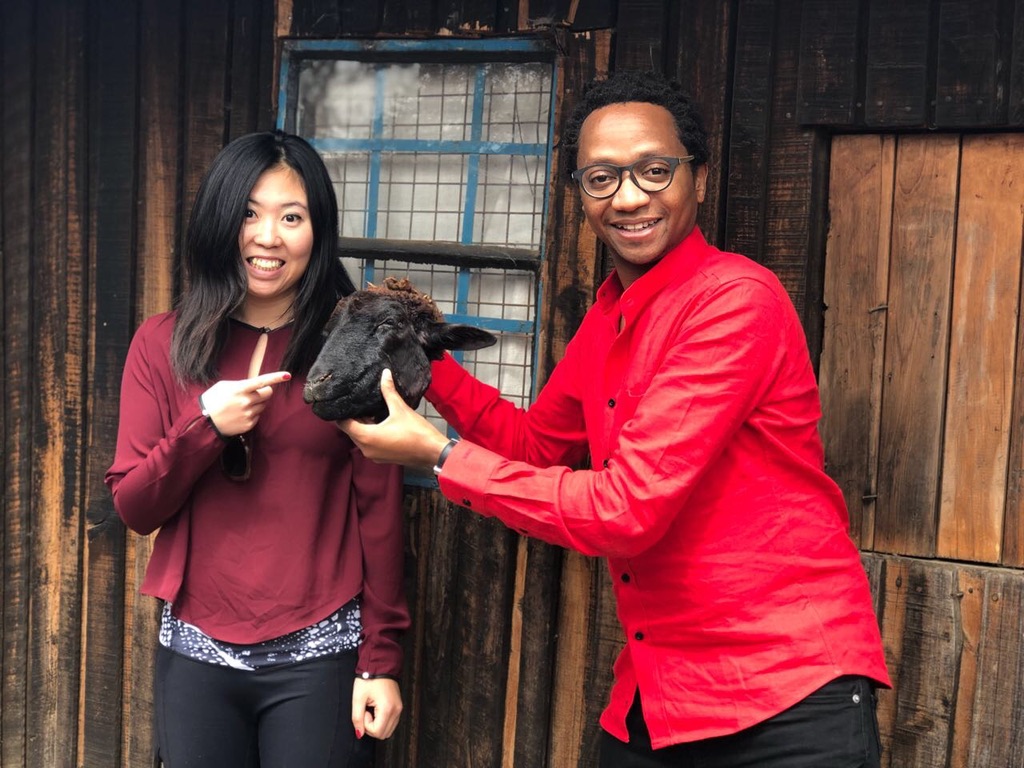
The first cross-cultural couple story is of course OURS! We are a proud Chinese and Kenyan fusion. Even though we grew up in very different parts of the world, we found many similarities in our cultures and values.
We have traveled to seven continents and over 80 countries, and met so many cross-cultural couples just like us! Hope you will enjoy our couple story series and learn something from their conversations!
How did you meet?
Fiona: We met at Shanghai Hash Harrier in January 2014. It is an international running club, or better known as a “drinking club with a running problem”.
Elvo: We met at a social group; Shanghai Hash House Harriers, the drinking club with a running problem
When did you realize you love your partner?
Fiona: To me it’s a long and gradual process. We’ve been good friends for over four years and know each other really well. I think that’s the foundation of a strong and healthy relationship.
I was traveling in Kenya during Christmas 2017 and he invited me to celebrate with his family there, there brought us closer, we were still just friends then.
We were then traveling a lot to each other’s city for work and inevitably spent a lot of time together. That’s when the nature our relationship started to shift. At the beginning it was really casual, but because of our history, it didn’t take long for me to develop deeper feelings for him. I am not sure there was an exact moment when I felt in love, but I remember we could spend the entire weekend together 24/7, be completely myself and happy. I also started making adjustments at my job and make time to travel and see him, which was not something I normally do. It just feels so natural.
Elvo: There isn’t a moment I can point to when the “fall in live” part happened. My feelings towards her grew stronger and stronger to a point where I cannot imagine myself in a relationship with anyone else. When this moment happened exactly I have no idea
What perceptions did you have of their culture? Did they live up to it?
Fiona: I didn’t have much knowledge of Kenyan culture. I think we had pretty bad media representation of Africa in general. I am embarrassed about it now, but I thought Africans are poor and happy, and they are physically stronger with musical talents.
And NO, he doesn’t fit into those stereotypes at all. Lol
Elvo: I always thought of Chinese people as harsh and rude. When I heard Chinese people speak Chinese it always sounded very harsh and when they spoke English the grammar due to lack of articles, verb/tenses and word order.
Chinese people are generally not rude. There are some assholes here and there just like in every culture. Once you understand the reason behind the language then it doesn’t come across as rude anymore, just different.
Have you had arguments or misunderstanding due to cultural differences?
Fiona: Our arguments are more about our personalities than culture, I realized Chinese and Kenyan culture actually have more similarities. One thing I didn’t quite understand was the “expanded obligation” – if you are considered successful, almost anyone who knows you feel entitled to ask for a favor, most of the time financially, and you are obligated to help. In China we only have that responsibility to our parents and close families. It made me think about the “black tax” mentioned in Trevor Noah’s book “Born a Crime” : “Because the generations who came before you have been pillaged, rather than being free to use your skills and education to move forward, you lose everything just trying to bring everyone behind you back up to zero.”
Elvo: Yes. There are several misunderstandings that I like to attribute to my partner being from the one child policy era. There are compromises, unspoken responsibilities, expectations etc that one has to their direct family/ siblings or large extended family are difficult to explain.When I attempt to explain them it doesn’t make sense why I should have these obligations when I say it out loud. This leads to the answer “Because I have to do it” which is never adequate enough.
Is there anything cultural your partner does that you like or dislike?
Fiona: I like how easy it is for him to instantly connect with someone from his culture, he can call at a black guy on the street and minutes later behave like they are best friends. We are more reserved in that way
I dislike unpunctuality in general. I was taught to always be on time if not early, but Kenyans are usually more chill with their schedules.
Elvo: Not particularly.
Is there anything in your partner’s culture that you also have started doing?
Fiona: I started throwing in a few simple Swahili words here and there.
Elvo: I use a lot of Chinese filler words in general conversation. This is not something that I picked up from her but rather from my interaction with many other Chinese people.
What are some of the products that you didn’t know your partner uses?
Fiona: Mostly hair products, and the special hairbrush, the silk hair cap for sleeping etc.
Elvo: Beauty face masks
ON FOOD
What food does your partner eat a lot from their culture?
Fiona: When we go to Kenyan, a lot of Nyama Choma (roasted goat) and Ugali (cornmeal bread). But he lives in the US, so not so much Kenyan food.
Elvo: She doesn’t eat much Chinese food. I crave and want to eat Chinese food more than she does
What food do you love from your partner’s culture?
Fiona: Nyama Choma (roasted goat)
Elvo: Xiaolongbao (soup dumplings), spicy Sichuan and Hunan food, hearty Xinjiang food
What food from your partner’s culture is weird to you?
Fiona: I am Chinese so no food is weird to me
Elvo: Chicken feet (people from some parts of Kenya eat these but we don’t in my part), stinky tofu
Is there any food in your culture that’s similar to your partner’s?
Fiona: Our street BBQ (Shao Kao) is similar a little similar to Nyama Choma. Our meat stew is a little similar too.
Elvo: A lot of Xinjiang food is Kenyan food in disguise. Just replace the lamb with beef and it’s a match
ON LANGUAGE
What cute phrases have you learned from your partner’s language?
Fiona: Sawa Sawa (Ok Ok) Kanono (little fatty) nakupenda (I love you)
Elvo: So so so many. Xiao pinguo (little apple), xiao ke ai (little cutie)… basically just add a xiao (little) in front of any word and make it cute
What are the words/phrases your partner always says in their language?
Fiona: when he speaks Swalihi – NiNi (I am still not quite sure what this means, more like a filter between sentences)
Elvo: Hmmmm, none actually
ON ENTERTAINMENT
Do you listen to music from your partner’s culture? Do you have a favorite song?
Fiona: I started to; I really like Malaika by Nyashinski
Elvo: Of course! So much KTV too. Xiao pinguo, women bu yi yang
What festivals in your partner’s culture do you celebrate together?
Fiona: Christmas
Elvo: We haven’t per se celebrated any in a traditional Chinese way
What children’s tales are important in your culture?
Fiona: Our children’s stories are often lessons from historical figures, derived from Chinese proverbs with a meaningful value to teach.
Elvo:
– Tales around not being greedy come to mind first “No feast for kiundu”
– Slow and steady win the race “Haraka haraka haina baraka”
ON PARENTS
Have you met your partner’s parents?
Fiona: Yes. Met dad twice during Christmas 2017 and 2019 in Kenya. Mom during Christmas 2019 in Kenya.
Elvo:
Dad – Virtually in the COVID-19 era. He forced me to take shots
Mom – Virtually in the COVID-19 era. In-person for a very short time (3 minutes) long before we started dating
Did you have any concerns about meeting them?
Fiona: The first time we met we were just friends, so there was no concern. The second time I wasn’t sure how they would react to a foreign girlfriend, and if they hold traditional expectation.
Elvo: I was worried whether they would be OK with me being Black and African
Did your partner’s parents do anything that surprised you?
Fiona: Not specifically his parents, but parents in Kenya in general, I was a little surprised by the way they order their kids to do stuffs (especially polishing shoes!). Also how obvious role seniority plays in the family – if you are older, you can order the younger around, it’s so natural to them and so bewildering to me.
Elvo: They seem to be really chill. I had not expected them to be as chill
FINAL WORDS:
What is the best part of being in a cross-cultural relationship?
Fiona: The endless opportunity to learn about a different culture, to discover new and interesting things about each other, to clear some of the prejudices and stereotypes, and to be more aware of important issues such as racism.
Elvo: Learning more about how we are just the same people who think we are so different but are really just the same
Has this relationship changed you? How?
Fiona: It has changed me but not really related to our cultural difference. I was very much a free spirit and this relationship taught me more about sacrifice, compromise, commitment and patience.
Elvo: Of course. If you haven’t been changed in a relationship then you haven’t been in one.
FIFINONO Culture Learning:
Similarities in Chinese and Kenyan cultures.
FIFI and NONO learned a lot about each other’s culture. We discovered that there are more similarities than differences between us. Especially about family and community, filial piety, respect of the elders, and also more traditional gender roles in the society.
Finding the commonalities between different cultures is one of the main goals of our blog What are some of the values you share with your loved ones from different cultures?
Are you in a cross-cultural relationship? Would you like to share with us your stories, learnings, and tips? Would you like to have your couple sketching on our website?



 FIFINONO - a blog about cultural exploration
Leave a comment