Why are you the land of happiness?
I came to Bhutan bearing that question in mind, trying to unveil her mysteries, discover her secrets, and hopefully take the receipt home with me.
But as you may already guess, it’s never that straightforward.
I was quite excited when boarding my Drukair flight – Bhutan’s own Royal Airline. It was founded in 1981 and was the only airline flying into Bhutan until 2010. The road system didn’t exist in Bhutan until the 1960s and the country didn’t have any waterways or ports. It’s hard to imagine how Bhutan was still so isolated from the world just a few decades ago.

I was warned about the drastic landing at Paro airport. It’s said that only 10 pilots in the world are qualified to land here due to its complicity. Our plane flew through the valley and flirted with the surrounding mountains. I was busy admiring the beautiful rice fields out of the window when our plane suddenly touched the runway. There was no sight of the airport until the last minute.
I could enjoy the ride longer!
Traveling alone in Bhutan is still impossible for most nationalities. When I got out of the airport, my guide Kinza and driver Namgay were already waiting for me, wearing their traditional Gho, a knee-length robe that looks a little bit like kimono. I was self-obsessed enough to think they were dressing up for me until I noticed almost everyone else was dressing the same way.
How authentic and original! Completely untouched by Western civilization! I thought.
Then I heard David Guetta in the car while both of them started peaking fluent English to me.
I could only afford a few days in Bhutan due to the USD 250 daily minimum spending. So I expected a tight schedule with too many things to see. Instead, I was in for a calming detox retreat. There were not so many “wow” attractions to overwhelm my senses, but the lasting serenity, harmony with every living being in nature, and the unpretending and modest way of living were constantly cleansing my body and soul.
My trip started from Thimphu and ended in Paro, driving through Punakha and the Paro valley. Thimphu is the only capital in the world that still doesn’t have traffic lights. When I was impressed by how quiet it was, Kinza told me it was the busiest place in Bhutan.
No matter where we go, I could always feel the presence of Buddhism. It was brought to Bhutan by Padmasambhava in the 8th century and now about 70% of the nation are Buddhists. At the many ancient monasteries we visited, Kinza patiently told me histories and legends of Buddhism in Bhutan. There were also forbidden stories that he’s not supposed to say, otherwise, it would bring bad luck to both of us. The locals ignored the presence of tourists and performed their prostrations from all angles. I sometimes felt awkward, worried about where to stand so I don’t block their prayer or blessings.

Dzong is a Buhutan’s distinctive type of fortress. It’s often made of wood with delicate carvings. (Until 1998 all buildings in Bhutan must be constructed with multi-colored wood frontages) Kinza explained the functionality of each section as we walk, the ministries and monastic body are so harmoniously housed together. I had always believed secularism is the best way to govern a nation, perhaps I should rethink in Bhutan.

In Bhutan, just watching locals’ daily routine could be fascinating: wandering through the farmer’s market, smelling peppers and tasting apples; watching the archery players sing and dancing after they hit the target; sitting next to the suspension bridge and drinking “Drunk 11000 Super Strong Beer”…
When you are on the road, the most ordinary thing can become an adventure.


There are a few galleries around town, I walked in one and admired the Thangka and mandala mixed with the contemporary interpretation of traditional Bhutanese art. I stopped in front of a painting with a male and female deities in a shocking sexual position.
“What does that represent?” I asked the owner.
He explained patiently that this is the Yab-Yum symbol commonly seen in Bhutan, The male figure represents compassion and the female partner represents wisdom. Only by uniting with each other could they both reach enlightenment. 
Growing up in a man-dominated society, I had been competing with men all my life, trying to prove that I am not weaker, less intelligent, or competent. But even when I finally caught up or exceeded in some areas, I still worried about falling behind in others. Perhaps we are not meant to compete, perhaps we should use our advantages to compliment each other’s weaknesses and move forward together.
Yab-Yum was quite subtle compared to the Phallus Deity – The “Divine Madman” Lama Drukpa Kunley. He was probably the pioneer of unconventional teaching, drinking wine, and giving women blessings by sleeping with them. It’s also said that he created Bhutan’s national animal Takin by cutting the head of a goat and attaching it to the skeleton of the cow.

According to Drukpa Kunley, “Happiness lies below the navel.” He turns his penis to a “Flaming Thunderbolt” and uses it to subdue the demons. Now paintings of Phallus can be seen everywhere in Punakha and people from all over the world come here praying for fertility. And apparently, locals are quite creative with it.


Sure, I’ll let my kids play next to a penis on the wall.
Contradictorily, regardless of Yab-Yum and Drukpa Kunley’s teaching, the monks and nuns here remain celibate and consider sex as a sin. And while many ancient tribes and believes worship phallus, sex in the modern world is often seen as vulgarity or even taboo in some societies. What happened when we started to control sexuality? Today we think we are sexually liberated, but perhaps we are nowhere closer to our ancestors.
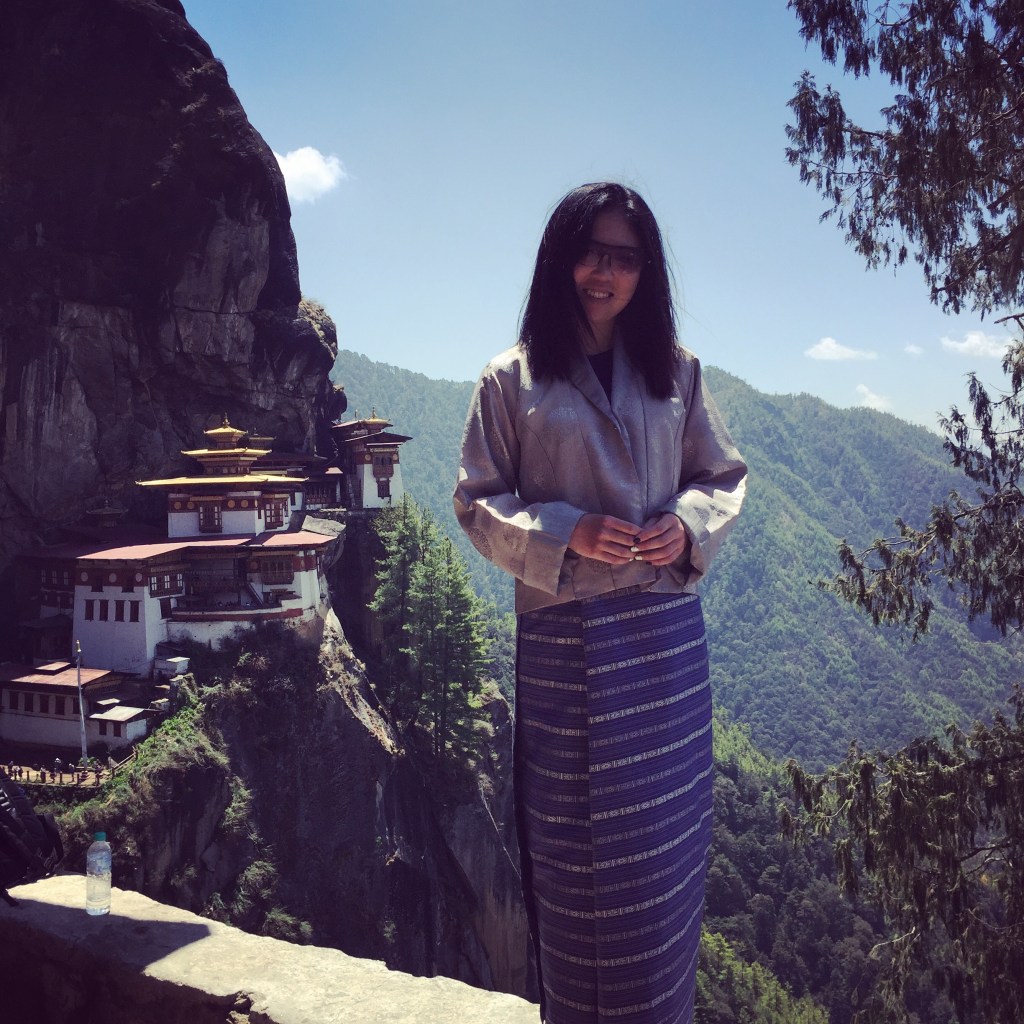
We’ve saved the most famous attraction to the last – Tiger’s Nest. One of the most well-known monasteries hugging the cliff above 3000m. Legend says Padmasambhava came here with a flying tigress. To admire her magic, we have to climb about 2 hours up in the mountains. Another option is to ride a horse for the first half of the trail.
I somehow always felt uneasy watching animals carrying people on the mountains, but didn’t know exactly why.
“This is not good.” Says Kinza watching a group of tourists passing by on the horses. “You build your pleasure on other’s suffering.”
Maybe that is the cause of my unease. I thought about animism – the belief that all things in the world have spirits. Since when we human beings started to think we are the center of the world, and we are so superior to other creatures that we can do almost whatever we want to them?
The trail felt fairly easy after trekking in Nepal. We went through emerald-green mountains decorated by colorful prayer flags, passed waterfall that looked like silver tears on the wrinkled face of the mountain, and watched the monastery getting closer and closer.


After the final steep stairs, we finally made it to Tiger’s Nest in about 1.5 hours. I left my camera, phone, and backpack outside, removed my shoes to visited the three temples, then peeked in the cave where Padmasambabva is said to have meditated. As unspiritual as I was, I felt a sense of unexplainable holiness. So when Kinza was doing his prostrations I secretly made a wish and bowed with my mouth covered to let the holy water running through my hair.

One of the highlights of my trip was visiting Damien and Sonam’s home – a three-floor two-hundred-year-old house with beautiful carving and a shrine inside. This is a romantic story between a French physicist who realized the studying of the human body goes beyond cells and genes, and a Christian taught Bhutanese girl who lived the high life in Europe and felt something was still missing when she almost had it all.
Then Buddhism brought them together.
Now Damien is the director of an international Buddhism organization Nepal branch, managing events and translating scriptures to English and French. They recently moved back to Bhutan with their three-year-old boy mainly to take care of Sonam’s mother.
“I used to wear designer brands, take on luxury vacations, and date rich guys. But now I don’t miss that life.” Says Sonam,” Now I don’t have to put on my maschera every day anymore. I am comfortable just being who I am and do what I want. And when I look at the red carpet on the TV, I don’t think ‘wow I wish I could have that.’”
I don’t have that peace, not yet. I am still not completely comfortable with how I look; I felt the impulse to make a booking whenever Four Seasons ads pop up on my Facebook, and when I see the glamor and fame on TV, I still want a piece of that. Perhaps I still need recognition, acceptance, and material rewards to prove my worth and value. To find internal peace, there’s still so much to work on.

My trip to Bhutan was almost over, but I still didn’t quite get their secrets of happiness. Yes, they have beautiful nature and less disparity, but also experience limited resources and slow development. There must be something else.
One day over lunch I asked Kinza about the national average income. He said it’s about USD 300.
“That doesn’t sound much, is it enough?
“How much is enough?” says Kinza, mixing the chili and rice with his hand, “You can earn so much more and still feel not enough.”
Then I realized how content Bhutanese are at the present moment. From the girl selling red rice at the market to the old lady turning prayer-wheels to the souvenir shop owner practicing her Chinese with me. Perhaps that’s part of the recipe I should learn.
I don’t know much about Buddhism teaching, but here’s what I understood: craving and desire is the cause of our suffering. When we are happy we long for more; when we are struggling we wish for it to end. So we end up chasing endlessly.
What if we accept that our desire, craving, and anxiety now won’t change what’s coming? What if we embrace happiness and struggle as they are? What if we acknowledge and appreciate every experience at this right moment, no matter it’s joy or sorrow, pleasure, or pain?
Right now, let me just enjoy this stunning view out of my window, and not worrying about what was coming.
I thought about a quote by one of my favorite writers Cheryl Strayed:
“How wild it was, to let it be.”




 FIFINONO - a blog about cultural exploration
Leave a comment