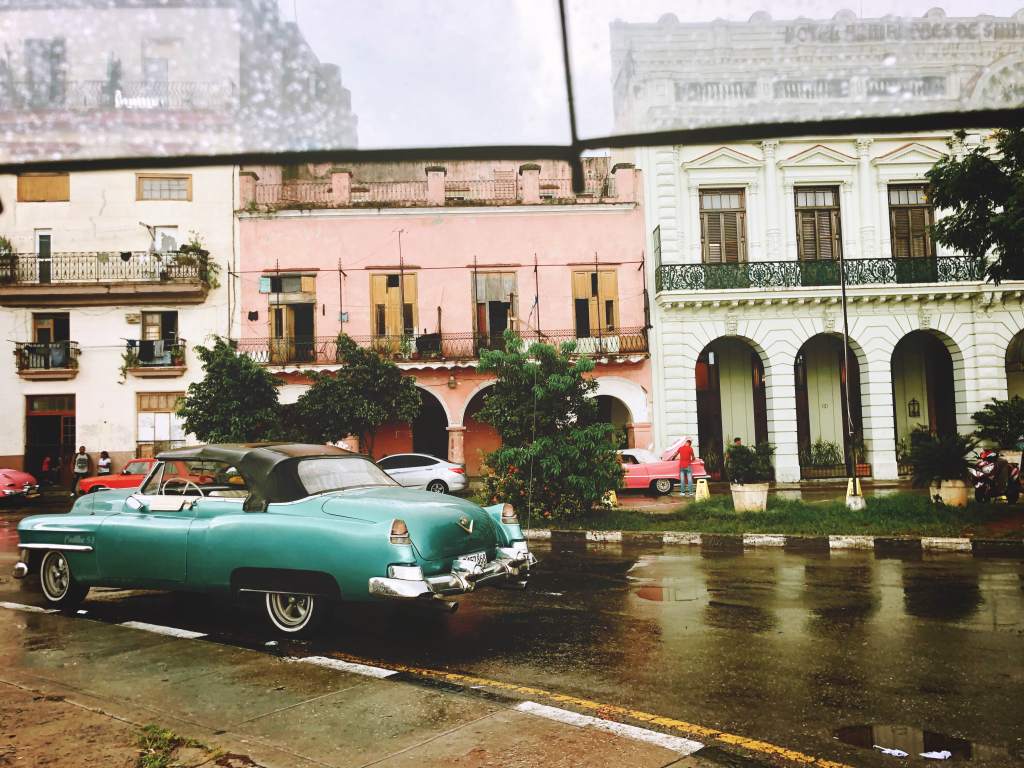
I sat on the Terrace of my Casa, sipping the freshly squeezed guava juice and watching the first sunray waking up the city. The tranquil morning of Havana is frequently interrupted by the harmonious melody of hummingbird and roosters, contrasting to the lively streets filled with upbeat Latin music and salsa steps.

Havana is like a live museum. Wandering around the ancient city, I felt I was lost both in time and space. Cuba is a country of contradictions: the grandeur of cathedrals and plazas is the representation of the country’s colonization eras, while the crowded Libreta stores ( government-owned ration shops which provide family minimums for rice, sugar, matches, and oil, etc) frequently reminded me that Cuba is under the communist regime. Tourists indulged themselves with mojitos and daiquiri at the rooftop bar of Hotel Nationale, while barely any Cubans could afford to enter and fancy government-owned venues targeting only the travelers.


“Holla! Are you Chinese?”
A tall, slender guy with the smile of sunshine stopped me on Obispo street.
“um, yes.”
He told me his Chinese name is “无极”, which means limitless in Chinese. He said he was studying Chinese, showed me pictures of him in Chinatown, and invited me to his uncle’s restaurant.
I was warned about “Jineteros” – the friendly and charming Cubans who illicitly offer service to travelers. It’s one of the creative ways the locals use to earn some extra cash on top of the humble $25 monthly salary. Other ways would be renting out rooms in their houses, opening up private restaurants, or selling souvenirs to the travelers. Sadly, prostitution is also quite prominent. I was told that almost 90% of the girls in the popular Disco club were “professionals”.
“Thanks but I am meeting up with friends.” I lied and politely turned down his invitation.
Solo travel in Cuba can be both challenging and frustrating. With extremely limited WiFi, under-developed public transportation and my tight schedule, I finally gave up and booked a guided tour.
Viñales
After about 4 hours bus ride, we arrived at the viewpoint of the Viñales, a charming town encircled by picturesque mogotes – dome-like limestone outcrops. It somehow brought me back to the south of China, with the emerald hills that rise abruptly from the flat plain of the valley. As I walked to the distance marker to check how far we were from the rest of the world, the “Statue” suddenly came to life and jumped towards me, followed by a kiss on my hand as an apology. The Cubans are always full of surprises.

The lush landscape in Viñales is largely rural in character, with simple family farms scattered over the plain. It’s also where most of the cigar is grown, so a visit to sample the finest tobacco from the source was inevitable. We hiked through the tranquil muddy paths, with local kids on horses frequently passing by.
“Don’t worry, we don’t have dangerous animals in Cuba.” Said our guide. “The most dangerous animals are mother-in-laws.”


The tobaccos are grown with traditional techniques continued for hundreds of years. No machines are used, fields are plowed with oxen and crops are picked by hand. I learned that the government takes 90% of the tobaccos at the harvest season, then selling them to the big cigar brands, leaving the locals with almost nothing.
The harvest season had already passed. So we visited the curing barns, where the toasty brown leaves are dried. When ready, the center vein of the leaf is removed, where most of the nicotine resides. Next, leaves are sprayed with “mojito” – a special mixture of ingredients (Of course rum is involved!) for the fermentation process.

The farm owner then demonstrated how cigars were rolled. We watched him effortlessly rolling the leave into the wrapper while stretching it to avoid any wrinkles as if he was working on an art piece. He then lit up the finished projects and passed it around for everyone to taste.

While cigar is considered a high-classes pastime in most parts of the world, in Cuba it belongs to everyone. Without the glamour and often superficialness, cigar seems more enjoyable in the middle of Viñales farms.

The nature of Viñales doesn’t cease to fascinate. The next stop was the Indian Cave, where the Guanajatabey Indians built their primitive homes to hide. After a short path beneath the soaring ceilings and tight rock outcroppings, we boarded a small boat and started the trip down the spooky underground river, admiring the various rock formations along the cave’s walls.


As beautiful as it is, the cave has a tune of haunting tales. Slavery slaughters, massive suicides, as well as some unknown diseases, eventually made the Cuban aboriginal population to completely vanish. Seems to be a tragic pattern around the world.
Casa De La Musica has become our regular after-dinner activity in Cuba. The place is filled the Cuban rhythms and cheerful energy. As soon as I sat down, I was invited to the dance floor and spun like spinning tops, soon intoxicated by the combination of Havana 7 Years and the endless turns under the deep blue starring sky.
The musicality and passion are no doubt in Cuban’s blood.
Cienfuegos & Bay of Pigs
On the way to Cienfuegos, we stopped by the Bay of Pigs for snorkeling. This is a relatively remote region with the scattered sandy beaches and the limestone coastline.
Staring the turquoise and dark blue waters, I felt the breeze gently caressing my cheek and pictured the night of 16 April 1961, when a group of some 1,500 Cuban exiles trained and financed by the CIA launched an ill-fated invasion of Cuba from the sea. The ensuing battle with the Cuban Revolutionary forces resulted in the first defeat of a U.S backed take-over in Latin America. The US never stopped to try overthrowing Fidel Castro, yet he miraculously remained intact and is still considered a hero amongst the Cubans. His charisma, unique leadership style, and the stories of 638 very cunning assassination attempts stay a legend across Latin America.


We arrive at Cienfuegos around sunset. Founded by the French, the city appeal lies partly in the European flavor of its colonial hub, with a wide Parisian-style boulevard and elegant colonnades. Colonized by one country after another, each city in Cuba has its unique characters.


It was the Mid-Autumns Day in China, I watched the full moon rising from the peaceful ocean, leaving a golden reflection on the water. She has witnessed Cuba going through struggles, wars, and different regimes.

Trinidad
Walking along the enchanting setting of colorful colonial buildings and cobblestone streets, I was immediately taken by Trinidad. As Cuba’s best-preserved Spanish colonial town, the old part of Trinidad has been the UNESCO heritage site since 1988. I wandered the side streets and small valleys, passing by the brightly painted architectures, admiring the ancient frescoes and chandeliers in the mansions, taking in the city’s charm.


As a small town, Trinidad is extremely diverse. One of the highlights is her sparkling natural attractions. At Parque el Cubano, we hiked on the nature trails, passing by the swinging bridge, and finally arrived at the waterfall. One by one, we couldn’t wait to plunge into the deep natural pool, letting icy water refresh our bodies. I swam towards the waterfall, enjoying the water splashing on my face.

“Look at what I found!”
I followed the voice and spotted a lonely condom wrapper resting at the viewpoint. Well, I guess this spectacular scene is pretty hard to resist.
You just can’t come to Cuba and not take a classic car ride. Last day in Trinidad, we hired a one to take us to Marlin Marina. This museum-worthy car is older than my parents and most of its parts have been replaced multiple times. Sitting in it felt like traveling back in time.


We boarded our yacht at the Marina and soon started sailing towards the Cayo Las Iguana. The tranquility of the endless blue sea and sky seeps right into our bones. I lay on the net, feeling the refreshing water frequently splashing on my face, and staring at the clouds in the crystal blue sky. They constantly separated and reconnected, reminding me of the departures and reunions in life.

After a short snorkeling trip in the coral region, our yacht approaches the island. stretches of unspoiled, the white sand beaches revealed themselves, with palm trees swaying in the breeze ad the blue waters lapping the shores.


As soon as we walked on the island, giant rat-like Hutias and spikey Iguanas immediately surrounded us. Without the slightest intimidation, they followed us everywhere we went. What an unexpected welcoming party.


The island is serene and idyllic. I stuck my feet in the silky white sand and let my body sink in the crystal water. The sound of breeze and waves became the soothing lullaby.

Trinidad has my favorite restaurant and nightlife scenes in Cuba. Guitarra Mia is a magically romantic restaurant with live acoustic guitar, cobblestoned walls, and graffiti signatures. We were spoilt with a five-course meal and a surprising cigar treat at the end.

Before leaving Trinidad, one has to party like cavemen at Disco Ayala – the one and only dance club built into a natural cave 100 feet under the earth. We followed the stairs leading down to the gated entrance, passing through the tunnels into the jagged cavity, and heard a mix of techno and salsa music blaring.


“Do you know this place was the home of the serial killer Carlos “Coco” Ayala, who abducted children and murder them here!”
A local spoke next to my ear.
Sure! Let’s name the club after the cave’s murderous former inhabitant! Is that another kind of Cuban humor?
Santa Clara
Santa Clara is a key city in the Cuban Revolution. It was here that revolutionaries under the command of Che Guevara declared victory against the regime of General Fulgencio Batista. Walking through El Che” Guevara’s mausoleum and learning about his life through his personal artifacts, I tried to comprehend how a young man changed his life path and decided to become a Marxist revolutionary. Che remains the most iconic rebel in Cuba, with his figure appearing everywhere from wall paintings to T-shirts to all sorts of souvenirs.

The last night in Cuba, we stopped by El Morro during sunset. I watched the sun lighting up a fire in the sky, painting the city with summer fruit hues – glows of orange, tangerine, and gold. Sparkles on the streets lit up one after another, Havana is getting ready for another lively night.

As the fleeting colors of dusk began to fade away, I thought about my 11-day journey. There’s no place like Cuba, a country that is stuck-in-time, a country so resilient that survived colonization, revolutions, the fall of the Soviet Union, and the embargoes of the US. She stood tall with pride and charisma one battle after another. Yet problems are rising in Cuba today: the lack of economic development and of freedom leaves the young educated Cubans increasingly frustrated. I don’t know what’s in store for Cuba, but I know her charm will always remain. And I’d love to return someday, hopefully with better Spanish and Salsa skills.



 FIFINONO - a blog about cultural exploration
Leave a comment